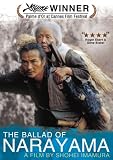
The Ballad of Narayama envisions a Hobbesian dystopia set in an impoverished village of feudal Japan. It's inhabitants don't simply live close to nature; they are a part of nature. In a lush valley landscape amid a lovely mountain backdrop, the villagers subsist much like animals, dependent on what little they can eke out of the land.
These farmers are filthy, malnourished, and vicious to one another. In the first half-hour of the film, we learn that they beat their kin, sell their children as chattel, throw their dead babies into fields as fertilizer and, when their elders reach the arbitrary age of 70, carry them to the mountains and leave them to die of starvation. This final pilgrimage is as much a sacrifice to the endemic hunger of the community as it is to the mountain gods, the gods who will supposedly reunite in the afterlife all those who perform the rituals they demand.
In this society, only eldest children have any value; younger ones are covered in rags and treated no better than slaves. Their teeth are rotting out of their heads. They form a despised underclass that is alternately neglected, abused, and raped. Life for them is, quite literally, nasty, brutish, and short.
Sex and death are ever-present, both in the human and the natural worlds; presented unblinkingly, these things are nothing to be surprised by, afraid of, embarrassed about, or sorry for. The peasants are impulsive and lusty, their songs bawdy and crude. They urinate and defecate openly. Mating, eating, excreting, dying: all are seen without shame as equally elemental and necessary functions.
Survival depends on dogged persistence in the face of adversity and on a ruthless willingness to discard anyone and anything, including sympathetic and filial emotions, that do not contribute to survival. Justice is swift and pitiless. A family that steals and hoards food is thrashed by a mob, their house is pillaged and, in short order, they are buried alive by a band of villagers. Not even children or pregnant women are afforded mercy.
While all of this sounds relentlessly miserable and depressing, the Ballad of Narayama is not without humor, since its characters are so human. They are petty and bumbling at one moment, proud and noble at another, and sometimes craven and courageous in the same breath. Much mirth arises from the stark contrast of these characteristics, and the extremes in the film make it impossible to forget that this is an over-the-top retelling of an ancient legend rather than a realistic or believable cultural portrait.
The central protagonists of the story are an irresistably wry old woman, Orin, who faces death despite her rude good health and indomitable vitality, and her son Tatsuhei, whose duty it is to abandon her to the wilderness. Yet Orin doesn't fear her imminent demise as much as she does the prospect that her son will not find a wife or that he will not have the nerve to carry out his obligations and thereby shame her before the other villagers, as his father did. She sets about arranging things with single-minded efficiency and a seemingly inexhaustible reservoir of joie de vivre.
The journey at the film's climax is predictably bleak, yet it has both a stark beauty and an unquestionable magnificence to it. The cinematography, as many reviewers have noted, is stunning throughout, as is the naturalistic acting of the cast. For an appreciation of a very Japanese esthetic, I highly recommend this cinematic masterpiece by Shohei Imamura, whose equally searing film Black Rain, about a family that survives the atomic bombing of Hiroshima, is also recommended.Get more detail about The Ballad of Narayama.

No comments:
Post a Comment